Journalism’s Non-Enforcement “Opt Outs” on Ethics & Disclosure
Among the U.S. and British alphabet soup of journalism "ethics" advocates / "regulators," is accountability only a posturing exercise?

As we soon wrap up yet another calendar year, my work with The #PRethics Community over these recent years has led me to ask a great many questions – many of them out-loud – to the “authorities” of the larger communication world, about why it is they do what they do.
In my journey this year, I stumbled upon some shocking information, pertaining to the U.K. journalism (press) sector.
I believe my U.S. PR colleagues will find the revelations I uncovered equally surprising as I did.
I’m unsure, however, if my British or other international colleagues will be surprised at all.
Either way, I certainly welcome everyone’s feedback.
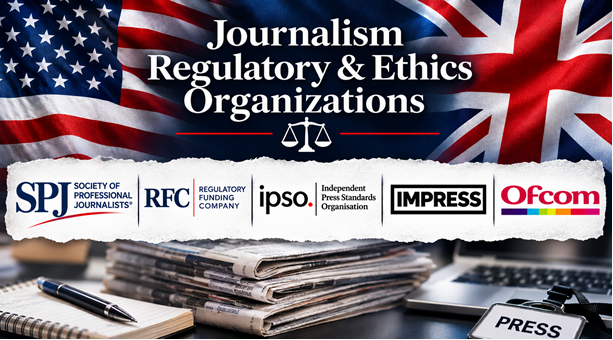
For starters, conflicts of interest in the U.S. journalism community are – or at least are supposed to be – a big “No-No,” although avoiding conflicts remains merely a suggestion of aspirational “guidance.”
Notably, due to U.S. Constitution First Amendment requirements that steadfastly protect public speech and the press from government intrusion / censorship, there is no U.S. federal government authority that serves as a designated watchdog to regulate universal press content or enforce general “standards,” in any way, shape, or form.
Interestingly, President Biden tried to usher in a new, bizarre U.S. federal government online content-regulation and censorship scheme in 2022, with the apparent direct or indirect help of the PRSA U.S. PR trade association.
President Biden decided to place this woman — Nina Jankowicz (a PRSA ICON keynoter in 2020) — in charge of it. Her self-recorded sing-along earned her the moniker “The Mary Poppins of Disinformation”:
The whole politicized Biden so-called “Ministry of Truth” exercise was shut down in a matter of weeks, due to illegalities of its gatekeeping concept.
In the “can’t make this stuff up” department, Ms. Jankowicz later reportedly registered with the U.S. Department of Justice as a U.K. “foreign agent,” as I presume her fake British accent actually worked for her in other spheres:
With that odd history aside, a U.S. publisher or media outlet is still obligated to comply with U.S. law under the constructs of anti-fraud and anti-corruption provisions, which apply to everyone else operating in the U.S.
But that legal standard is very different than an “ethics” standard, and it requires far greater resources brought to the task of proving misconduct.
So, essentially, if a U.S. news outlet publishes something wildly biased / dishonest / misleading while using deceptive tactics in that storytelling, on purpose, there often is little that a victim of that dishonest coverage can do about it, particularly if the victim doesn’t have deep pockets financially to mount a legal campaign in courts of law.
Which explains a lot.
The imbalances of power are significant. And reputational damage from unethical journalism is very real and exceptionally threatening.
It underscores long-term U.S. public distrust and animosity that many Americans have felt toward news media for decades now.
The U.S.-based Society of Professional Journalists (SPJ) Code of Ethics received an overhaul in only this past year of 2026, including a range of tweaks on its conflict-of-interest-related provisions.
I must also be quick to add, however, that the SPJ Code is NOT enforced.
If an SPJ-member journalist violates the SPJ Code, essentially nothing happens to them, relative to a hard consequence. SPJ does not investigate complaints about Code violations, revoke membership, or engage in any Code-enforcement action.
Which explains a lot.
When I asked “the googles” to parse out the differences / updates in the SPJ Code’s “conflicts of interest” provision, Google’s A.I. produced a helpful graph that gave a side-by-side comparison of the old SPJ Code versus the new one, which only was adopted in recent months.
PR practitioners who deal at all with U.S. news media should take note:
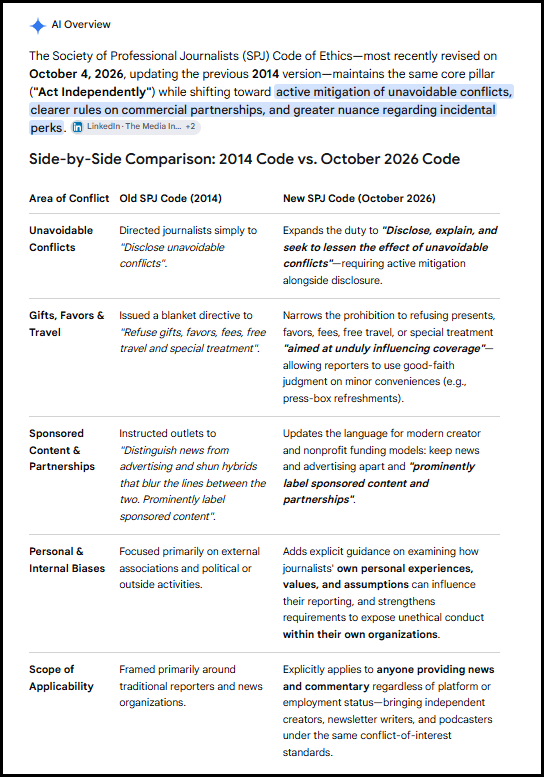
An entire other blog post could examine each of these changes, but staying on task here…
Many of these new provisions certainly appear compelling. But there again, we must remember: the SPJ Code is unenforced.
By contrast, the British journalism / new-dissemination community is a different animal…
Way different.
PR practitioners who deal at all with U.K. / British news media also should take note.
In the U.K., there exists a menagerie of press / journalism / newsgathering professional associations.
Hovering above them, specific authorities claim to “regulate” and “enforce” press standards and ethics.
But when you check under the hood and kick the tires of the full apparatus, there’s often more to it (or, far LESS, depending on your perspective) than meets the eye.
There are two U.K. print and online / digital news “regulators”:
1) the Independent Press Standards Organisation (IPSO, founded in 2014), and 2) the Independent Monitor for the Press (IMPRESS, founded in 2016).
Both of these fairly new regulators (only about a decade old) were spawned from revelations in the 2011-12 British Government “Leveson Inquiry” into “media misconduct,” following a British tabloid’s behavior of hacking the phone / voice mail of a murdered teen, Milly Dowler (and hardly the first or only such incident of similar types of alleged “hacking” by British reporters of citizens’ phone lines or other online records).
Video: https://youtu.be/jPFrBQqtEMQ?si=ovw7S5GkHqwl6TR8
The Leveson Inquiry documented massive ethical / legal-compliance failures in the British press and urged reform via an independent regulation set-up, backed by U.K. statutory legislation.
Interestingly, both of these print- / digital-journalism “regulators” (IPSO and IMPRESS) are opt-in for any British print / digital publication to volunteer to be “regulated” by either organization. Meaning, if a British PR trade publication (for example) doesn’t want to be “regulated,” they simply opt out – and off they go.
Which explains a lot.
However, there is also legitimate questioning of whether some media outlets who opt-in for “regulation” merely do it as a posturing exercise, to appear accountable, when they know full-well that it is unlikely they will be held to account.
This matter is particularly concerning, relative to the IPSO press “regulator,” which includes no “conflict of interest” provision in its compliance code beyond the very narrow scope of “financial reporting” — thus enabling IPSO-“regulated” publications to traffick in many diverse forms of conflict of interest, unchecked.
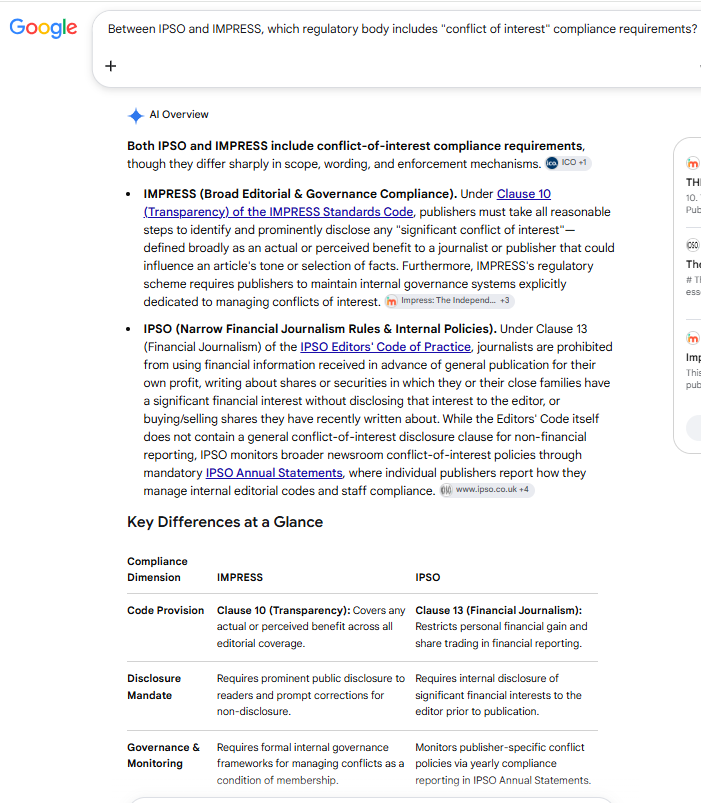
Of these two aforementioned U.K. print / digital regulators, only one of them (IMPRESS) is “recognized” under the Royal Charter on Self-Regulation of the Press (created as a direct result of the Leveson Inquiry), which audits regulators against 29 “Leveson Criteria,” as overseen by the Press Recognition Panel under the Royal Charter.
The 29 Leveson Criteria are – according to Schedule 3 of the U.K.’s “Royal Charter on Self-Regulation of the Press” – “the mandatory standards a UK press self-regulator must meet to be officially approved by the independent Press Recognition Panel (PRP).”
Online sources note that there indeed are 29 rules, but they are numbered from 1 to 23 due to six “sub-criteria” added during creation of the Schedule 3 development process.
Those criteria very much include “independence from publishers and politicians,” due to horrific outcomes from past conflict-of-interest failures in that regard.
To emphasize the point: IPSO is NOT “recognized” under the Royal Charter or “approved” by the PRP. Only IMPRESS is.
As a result, neither IPSO nor any press / digital outlets under IPSO’s so-called “regulation” are beholden to or compliant with the Royal Charter on Self-Regulation of the Press.
Which explains a lot.
A full list of IPSO “regulated” publications is available on the IPSO website: https://www.ipso.co.uk/who-ipso-regulates/
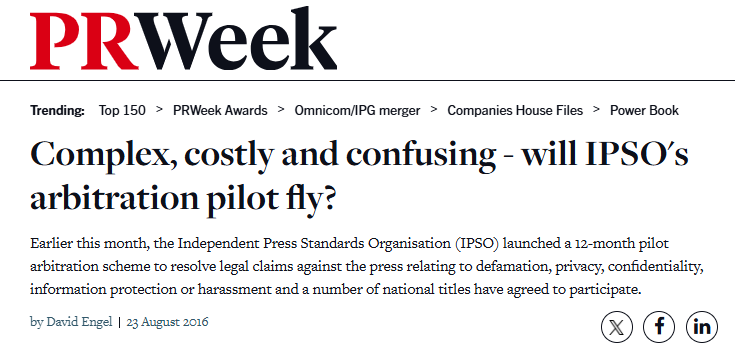
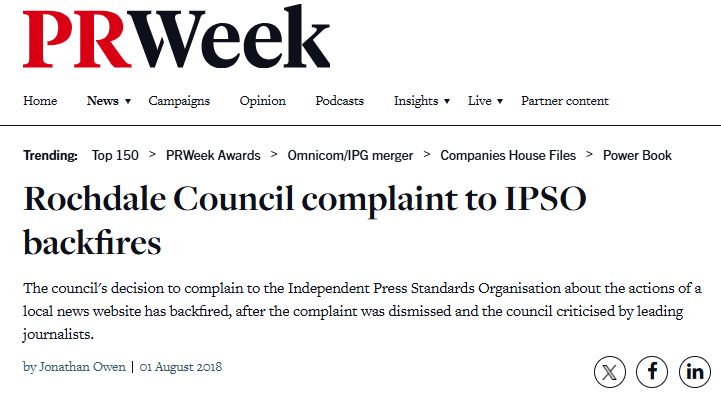
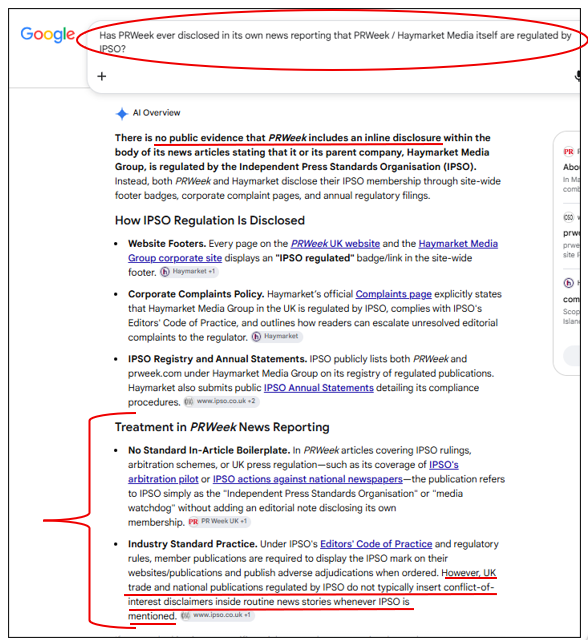
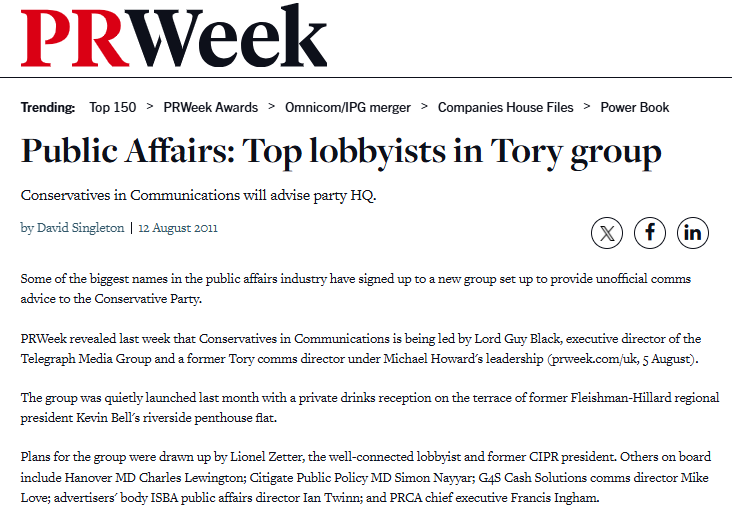
Notably, included on this IPSO list that is not covered under mandates of the Royal Charter is the PR industry’s own ultra-powerful Haymarket Media, publisher of both the U.K. and U.S. versions of PRWeek.
The online record includes no disclosure by PRWeek within its own news dispatches that its own publisher operates under the IPSO regulatory thumb when PRWeek has reported on other IPSO-related stories — which would appear, by any reasonable disclosure standard — to be a notable omission:
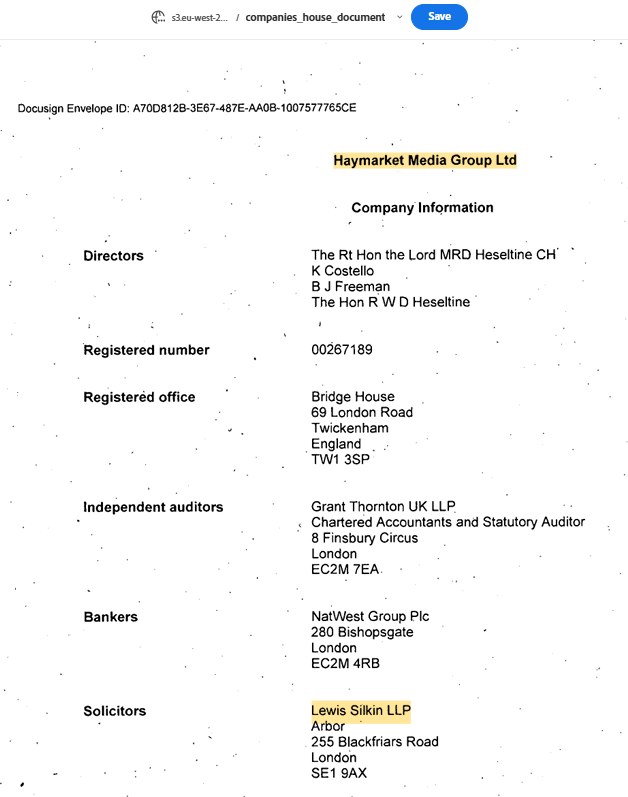
According to its filings at Companies House, for the 2025 financial year ended June 2025, Haymarket Media reported £175 million in revenues (or, as the British say, “turnover”) and an annual profit of £11.5 million.
Its Companies House filings also reveal that Haymarket employs as its “Solicitor” (legal counsel of record) Lewis Silkin LLP, which – according to filings by Haymarket Media to IPSO (see below for excerpt / screen shot) – is allowed by Haymarket to pre-screen news / editorial coverage by Haymarket news publications such as PRWeek.
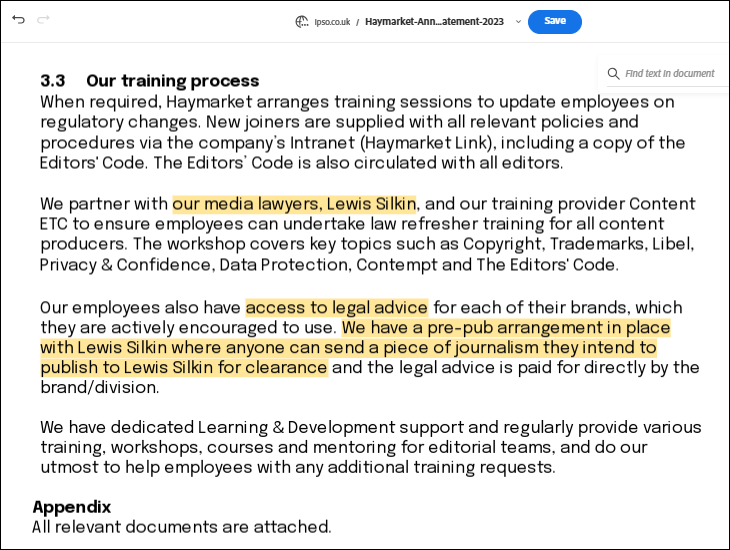
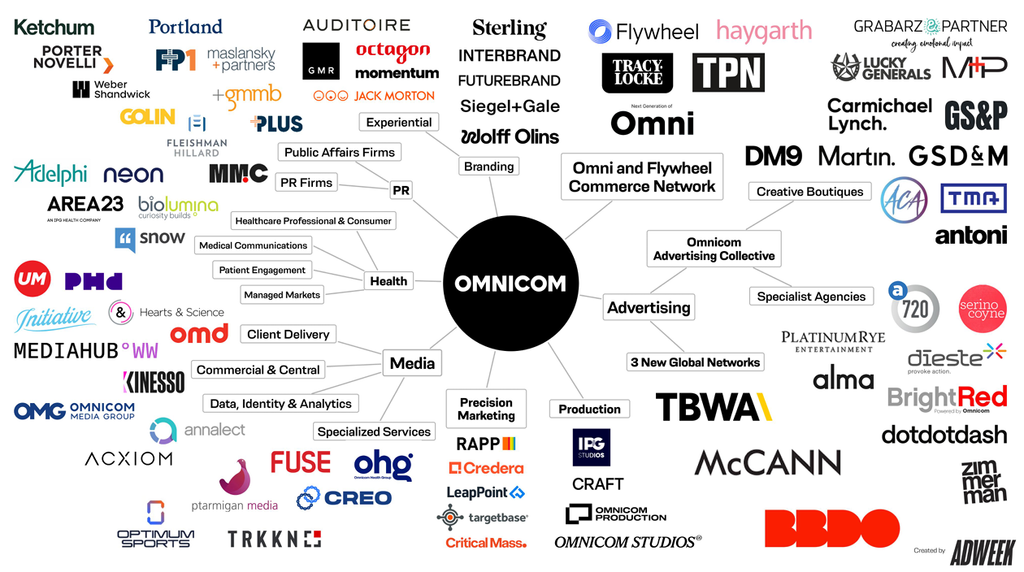
What further complicates this Haymarket / IPSO set-up is that Lewis Silkin LLP also just happens to be the very same multi-decade legal counsel of record to the U.K.’s PRCA trade body and to the U.K. operations of the largest global PR agency mega-conglomerate in the world, Omnicom.
Lewis Silkin has also brokered the PRCA to offer Lewis Silkin services in a “legal helpline” scheme to other PRCA-affiliated PR firms, but without advance disclosure of all the competitor PR firms (the biggest and most financially powerful in the world) that Lewis Silkin already represents.
Cozy!
Put another way:
The London-headquartered Lewis Silkin law firm is simultaneously paid for its legal services rendered to the Omnicom PR agency / ad agency conglomerate (one of the largest brokers of advertising dollars globally, in at least the tens of billions annually), and to PRWeek (Haymarket), and to the PRCA.
All the while, Lewis Silkin is allowed to “pre-screen” PRWeek’s U.K. or U.S. news / editorial outputs (including any coverage of Omnicom for-profit interests as well as PRCA trade body “news”) in advance for suitability / “clearance.”
And, because this scheme is “disclosed” by Haymarket to IPSO (in rarely-seen documentation to the outside world), IPSO is just fine with that.
A wealth of additional documentation I’ve collected from both the media record and from direct correspondences by authorities document disturbing and obvious Haymarket + PR industry conflicts-of-interest.
And that’s not to mention other powerful PR agency interests that Lewis Silkin also represents – whether in court, or in its “pre-pub” duties and privileges and tinkering, as freely allowed by PRWeek, which enables Lewis Silkin an indisputable role to help hype (or censor / bury) “news” to the law firm’s other clients’ liking or competitive preferences.
Got that?
It explains a lot.
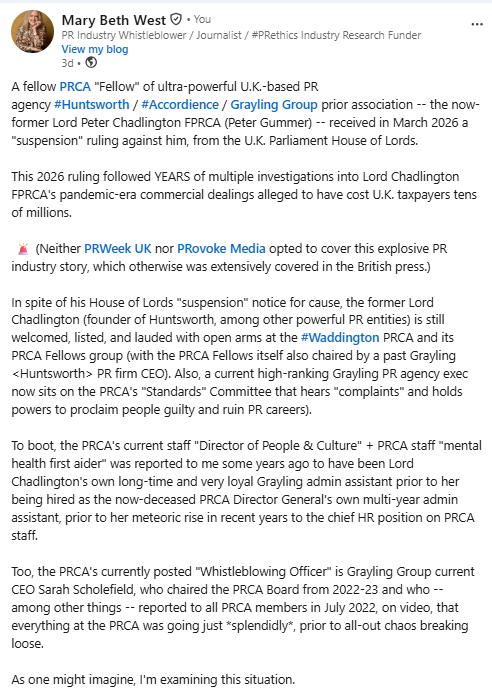
When I recently raised these related issues to PRWeek and also to IPSO, my concerns received a collective yawn from the powers that be.
As Hal Holbrook’s “Deep Throat” famously told The Washington Post’s Bob Woodard (played by Robert Redford) from the covert D.C. parking garage in the dead of night, in the film “All the President’s Men”:
“Follow the money.”
So.
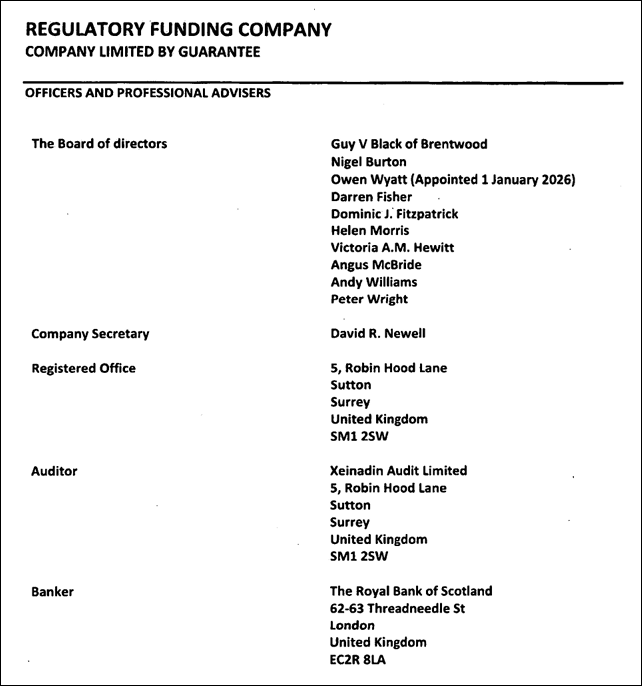
Who is on the Regulatory Funding Company (RFC) that funds this nonsense with IPSO and allows IPSO the budget to operate, perhaps underscoring why IPSO has been described as “a toothless poodle”?
Excerpt below / screen shot – Source: U.K. Companies House filing by Regulatory Funding Company (17 Nov 2026). The IPSO board of directors appears to be composed of eight men and two women, plus a male company secretary. Employer / publisher affiliations of these individuals on the board are not provided in the Companies House filing but are available online: https://regulatoryfunding.co.uk/
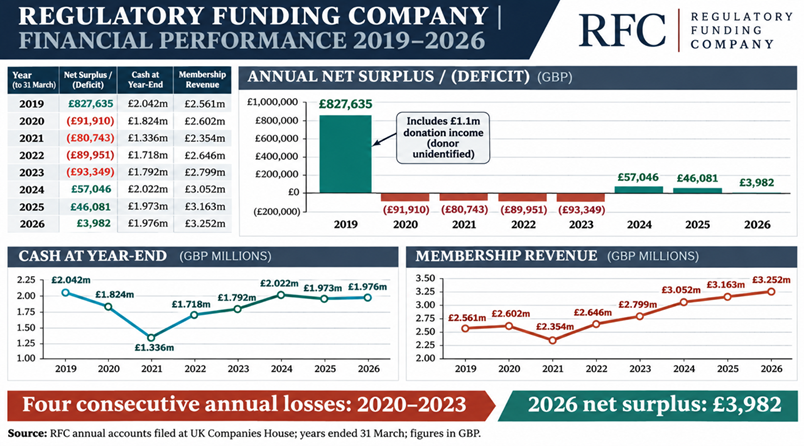
When I thumbed casually through some of the Regulatory Funding Company’s prior-year financial filings at U.K. Companies House, I discovered what appears to be — from 2019 — a £1.1 million set of “DONATIONS” to the RFC… but from whom, we have no idea.
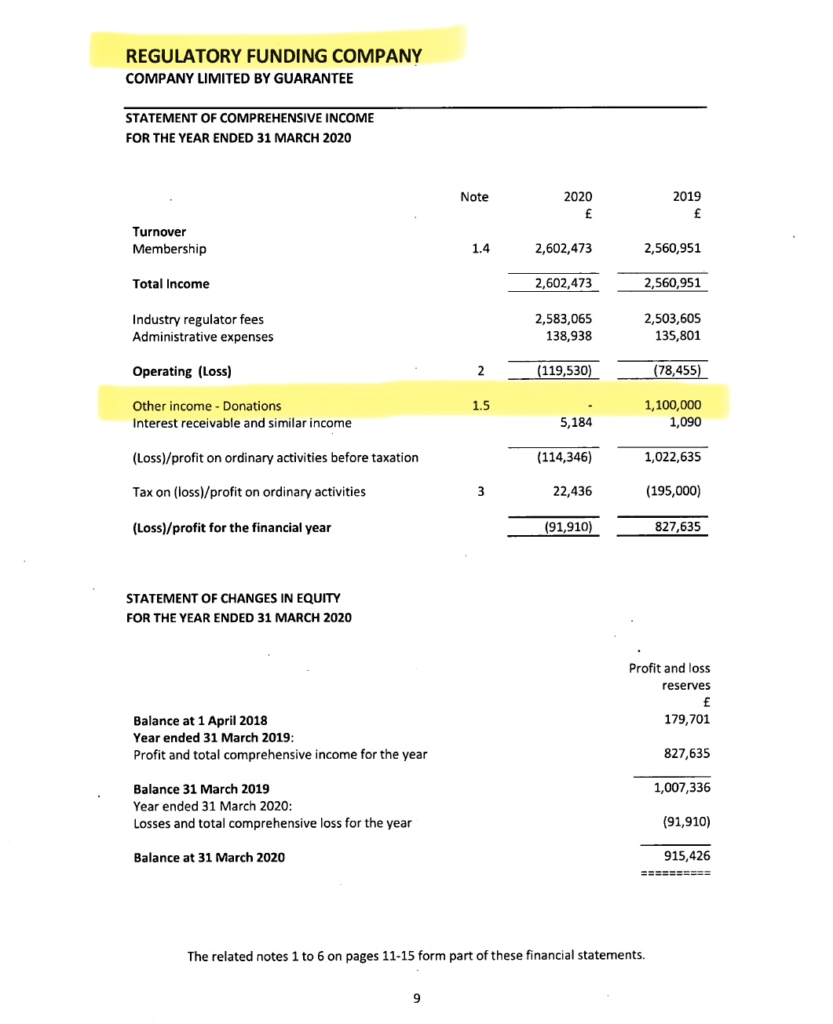
The identities of any RFC mystery donors, of course, matter.
Did the 2019 “donations” include generosity from major PR mega-conglomerates, seeking favor with RFC’s IPSO media-led governance body?
Were any “donors” affiliated in any way, shape or form with the infamous PRCA Bell Pottinger expulsion of 2017 (which PRWeek covered and lauded extensively)?
Did RFC “donors” include media outlets / publishers seeking a quid pro quo for a favorable outcome from having been under “investigation” themselves (or in anticipation of being under future “investigation”)?
Aside from these funny-money questions, we have to examine the manner in which IPSO is doing its job… or not.
According to a study published in “Ethical Space: International Journal of Communication Ethics” on 6 April 2024 by Prof. Chris Frost, entitled “The Independent Press Standards Organisation: Standard setter or complaints pacifier?” Prof. Frost wrote, “Ipso takes an average of 18,579 complaints (per year)…” but only “investigates an average 462 per annum.”
Which explains a lot.
(I myself submitted a complaint to IPSO in 2026 about more than one very serious matter, but IPSO dismissed it without bothering with an investigation — seemingly out of hand — while ignoring / dismissing, with no explanations provided, serious confidentiality breach appearances internal to IPSO’s board composition that occurred during my request for adjudication itself.)
Mr. Frost’s above-mentioned paper also observed:
“These figures do not suggest that Ipso is the startling success many would like to claim. It takes more complaints than the PCC year on year and adjudicates four times as many, but it only upholds 14.36 per cent of the complaints it investigates whilst the PCC upheld 42.5 per cent of adjudicated complaints. Neither complaints handler could claim gold standard results. Virtually all upheld complaints by both bodies concern relatively minor accuracy issues.”
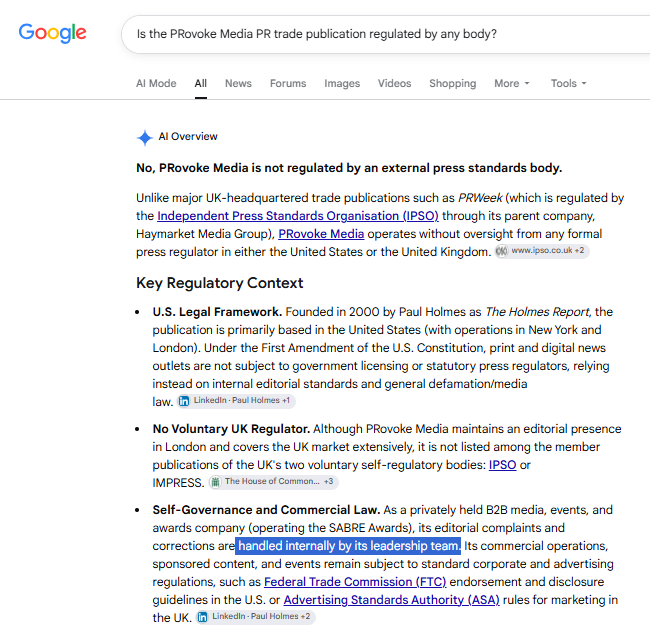
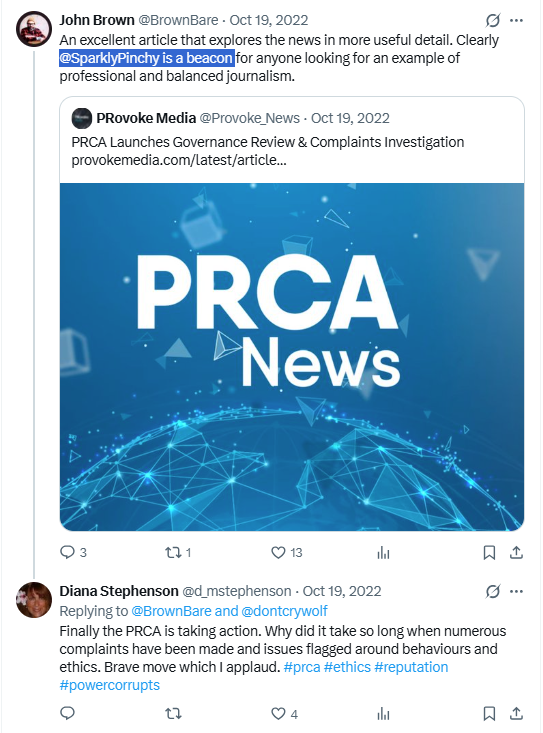
Meanwhile, U.S.-headquartered PR trade publication – PRovoke Media (owned by publisher Paul Holmes) – has never volunteered for “regulation” or compliance-oversight by either U.K. regulator (IMPRESS or IPSO), even though PRovoke focuses a massive degree of its PR trade media coverage in the U.K. market and operates a significant London presence with U.K-based staff, who have refused to respond to evidence-driven questions about their reporting practices.
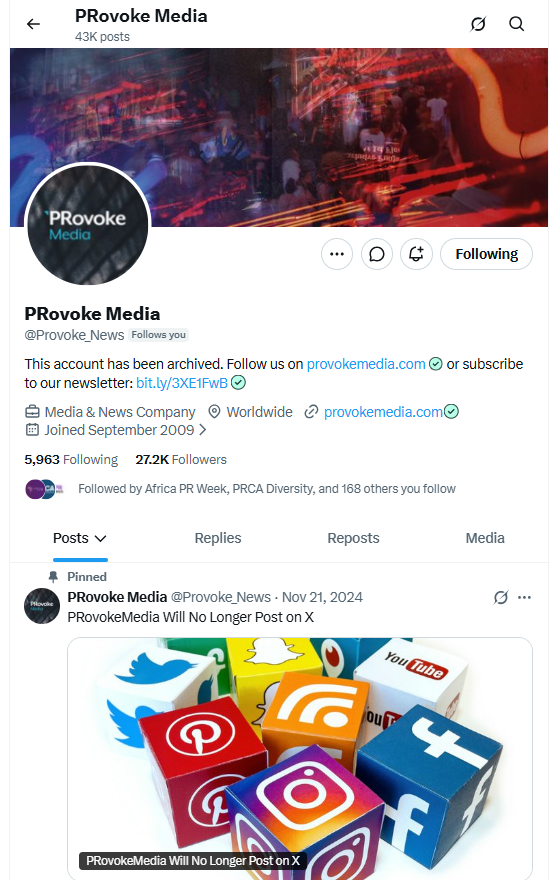
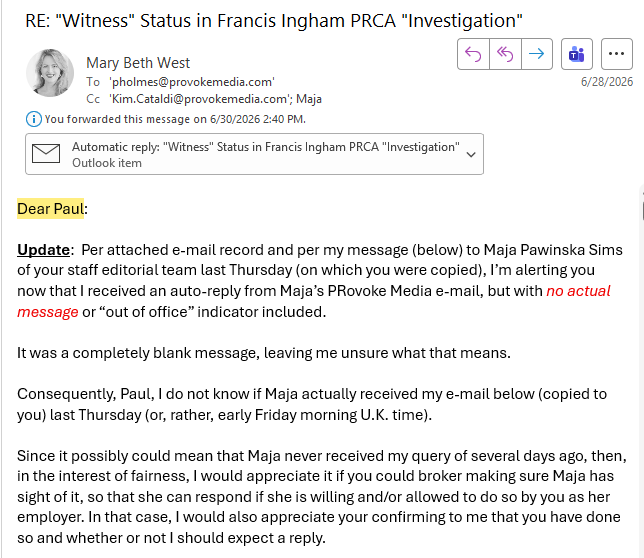
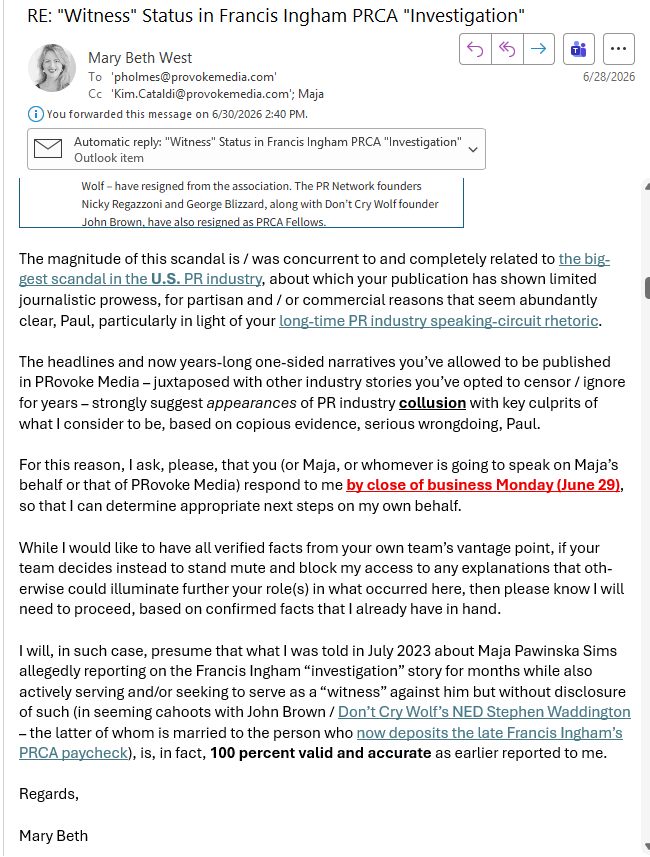
Online sources confirm that PRovoke Media opts to self-regulate and handle any complaints about its so-called “journalism” internally and with zero third-party oversight or accountability, which would seem to underscore serious concern when valid and evidence-based complaints that are repeatedly submitted to PRovoke officials are repeatedly IGNORED.
This stonewalling explains a lot.
Partial Excerpts (2) of e-mail sent 28 June 2026 to PRovoke Media Publisher Paul Holmes (no response ever received to multiple attempts at contact with PRovoke team members):
A separate British “statutory regulator” – Ofcom (Office of Communication) – oversees U.K. TV, radio, and video-on-demand news providers’ compliance with the U.K. “Broadcasting Code.”
Ofcom oversees British news outlets such as the BBC, Sky News, GB News and CNN International’s U.K. operations (Ofcom only enforces rules pertaining to channels / services licensed in the U.K.).
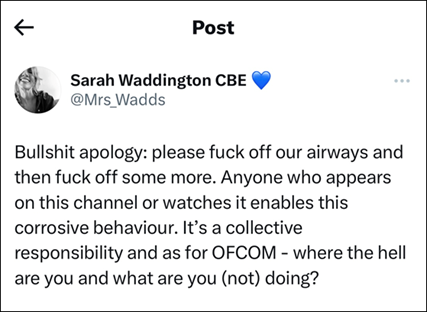
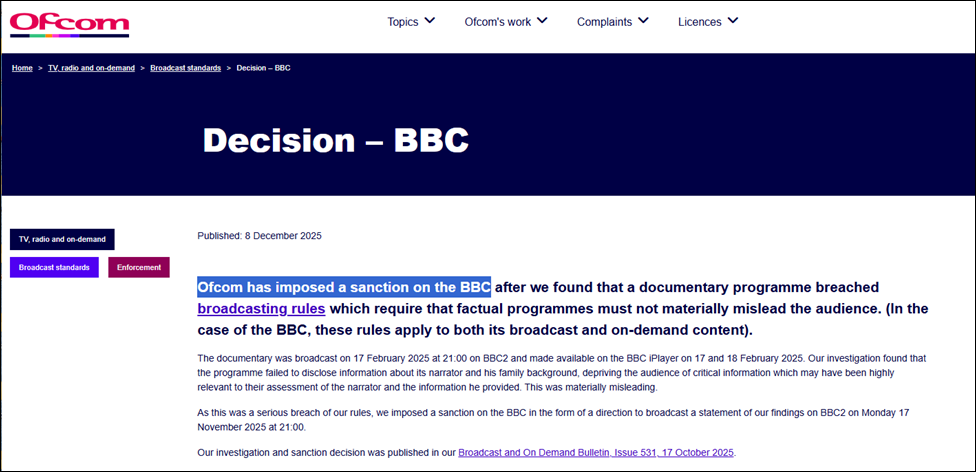
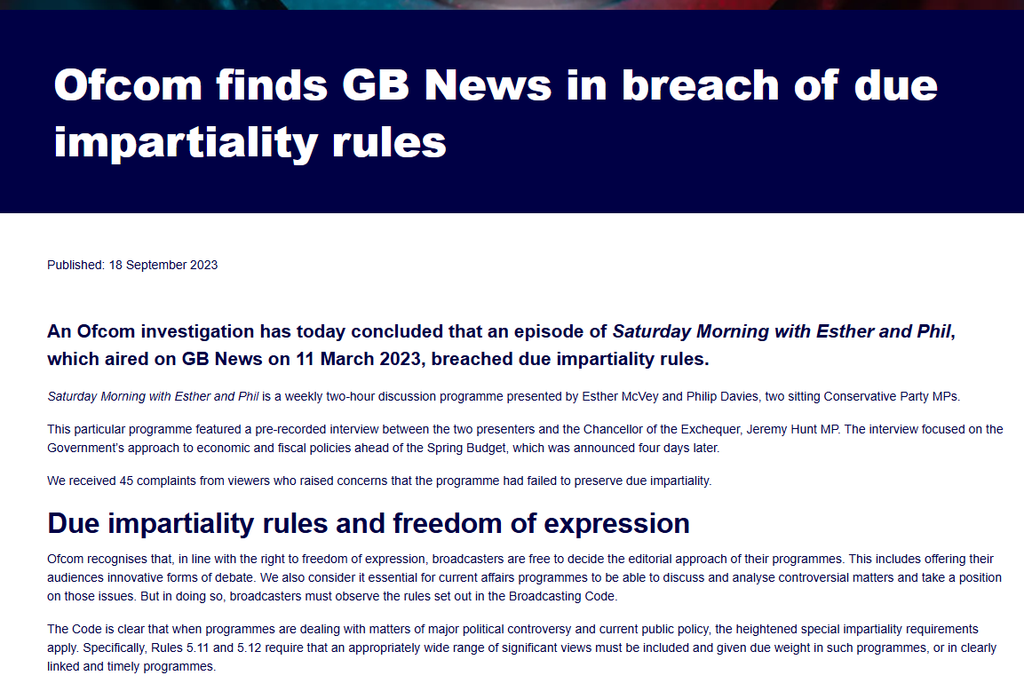
For its part, it seems that while not everyone will agree with everything Ofcom does (see PRCA CEO Sarah Waddington‘s tweet of fury against Ofcom from September 2023, the month she joined the PRCA’s own board of management — tweet now since deleted), Ofcom does seem to take definitive action – with teeth – if any licensed broadcast media outlet breaches standards.
And that’s good news – what precious little good news there is on the journalism ethics-compliance front.
Example / December 2025 (source: https://www.ofcom.org.uk/tv-radio-and-on-demand/broadcast-standards/decision-bbc):
Example / September 2023 (source: https://www.ofcom.org.uk/tv-radio-and-on-demand/broadcast-standards/ofcom-finds-gb-news-in-breach-of-due-impartiality-rules):
As these issues continue to evolve, The #PRethics Community will continue in our open discussions and engagement via LinkedIn and other platforms, to keep robust PR industry discussions active.
After all, if news media cannot be trusted as ethical and fair, it automatically harms the PR industry’s ability to foster trust with our stakeholders through news media and editorial reporting channels.
We all should work interactively (the news media side; the PR side; the ethics-compliance and enforcement side) to help each other be better – not working in collusion selectively, to block-and-tackle the very ethics frameworks and entities intended to maintain accountability.
Founder of The #PRethics Community on LinkedIn, Mary Beth West, APR, FPRCA has served as a PR industry whistleblower for some 10 years of her more than 30-year public relations career. Her work has shifted toward becoming a journalist herself, as the only individual in the global PR industry chronicling many specific problems that remain widely unaddressed and that harm PR industry credibility and advancement. Mary Beth West holds a bachelor’s degree from the University of Tennessee, where she attended the School of Journalism and was named by faculty as “Public Relations Student of the Year” in 1994.