
PRCA PR Trade Assoc in Cash Collapse, Per Filings to U.K. Companies House
Instead of answering questions posed since 2025 about major PRCA trade association issues, CEO Sarah Waddington has played The Blame Game.

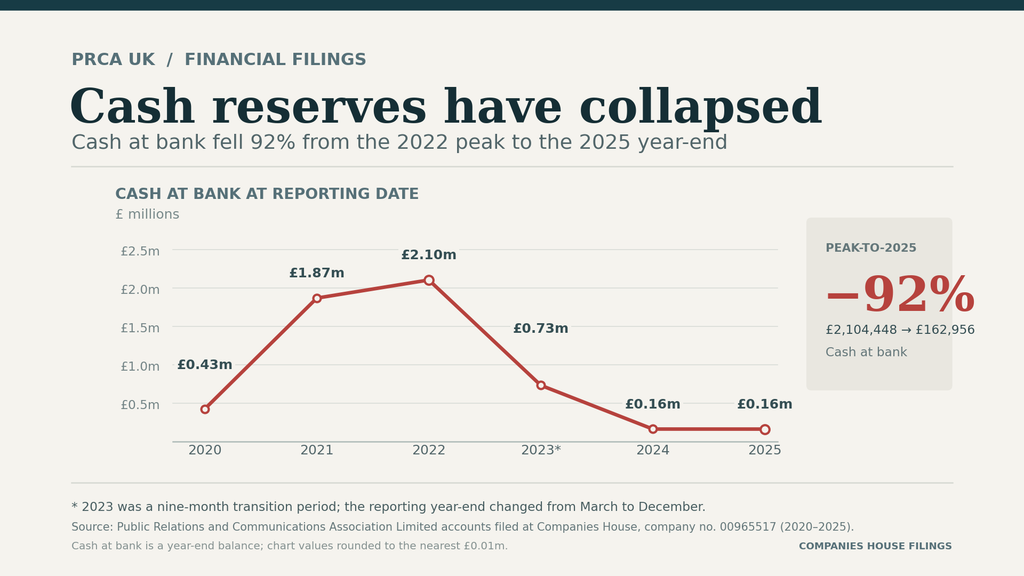
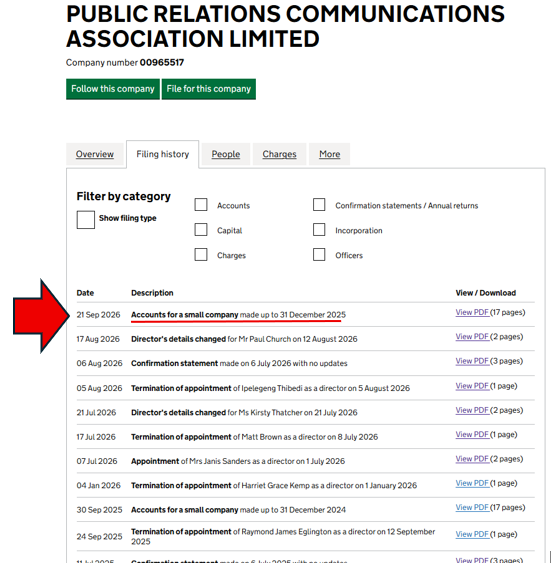
A veritable bloodbath of multi-year red ink has been (quietly) reported to the U.K. Government’s Companies House, by the London-based global PR trade group, the Public Relations and Communications Association (PRCA), under the PRCA’s “first female leadership duo,” in new filings posted for 2025 on 21 Sept 2026:
https://find-and-update.company-information.service.gov.uk/company/00965517/filing-history
Meanwhile, the PRCA appears to hope the industry won’t notice.
No apparent notifications about the Companies House filings were given on the PRCA’s website or on social media, nor was any formal 2025 Annual Report published, under current PRCA management led by CEO Sarah Waddington and her Board Chair, Kirsty Leighton (a.k.a. Kirsty Thatcher) of U.K. PR firm Milk & Honey.

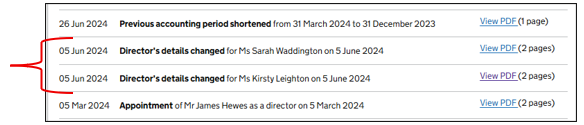
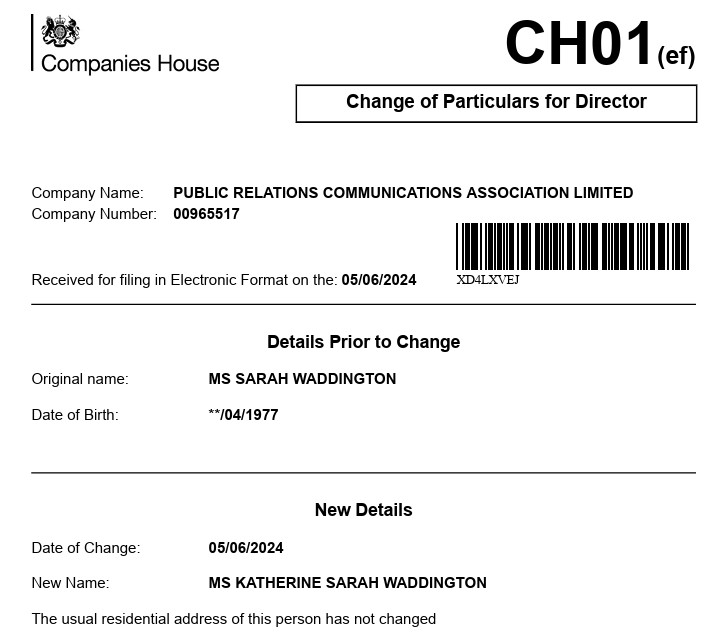
Notably, Chair Leighton is now known under the alias “Kirsty Thatcher“ in filings to Companies House in 2024, alongside CEO Waddington’s own change in name at the same time:
For her part, it appears CEO Sarah Waddington has been on an aggressive warpath for all of 2026, pointing fingers at others for her workplace woes.

When she’s not busy trolling and demonizing Sir Martin Sorrell and selling PRCA hoodies that bizarrely read “Flood the Internet” as a diss to Sir Martin, CEO Waddington has — as I only just learned last week — taken to the podcast airwaves, to complain about her job… and, apparently, to complain about me.
Even as of February of 2026, CEO Waddington claimed to have a “U.S.” “troll” dogging her as well as a “genuine stalker” based in the U.K. (as opposed to the “fake” kind, cleverly ginned up as a distraction tactic), with the latter allegedly having posed problems for CEO Waddington and her PR industry husband Stephen, years ago.
She claimed in this audio clip from her February 2026 podcast appearance (appropriately entitled “Embracing Marketing Mistakes”) to have engaged U.K. law enforcement years ago to address her “genuine stalker” situation, for purposes of “a restraining order,” but she further claimed police “cocked it up.” No word on where Mr. and Mrs. Waddington’s copies are located of their official police reports in their “genuine stalker” drama, to back up their claims.
EXCERPT LINK BELOW:
Amid the sobering findings of these latest PRCA financial reports, which themselves include alarming transparency problems and even discrepancies with public-facing records, serious scrutiny is owed from CEO Waddington playing the “victim” card while essentially communicating to anyone who dares question her that they, too, may be labeled a “stalker” or a “troll” (likely behind their back and without knowledge of the reputationally damaging accusations / innuendo), if they push back on her transparency problems, discrepancies, and financial losses.
This e-mail — as printed verbatim, below — was sent last Friday, 25 September 2026, near COB U.S. Eastern time, to PRCA Chair Kirsty Leighton / Thatcher:
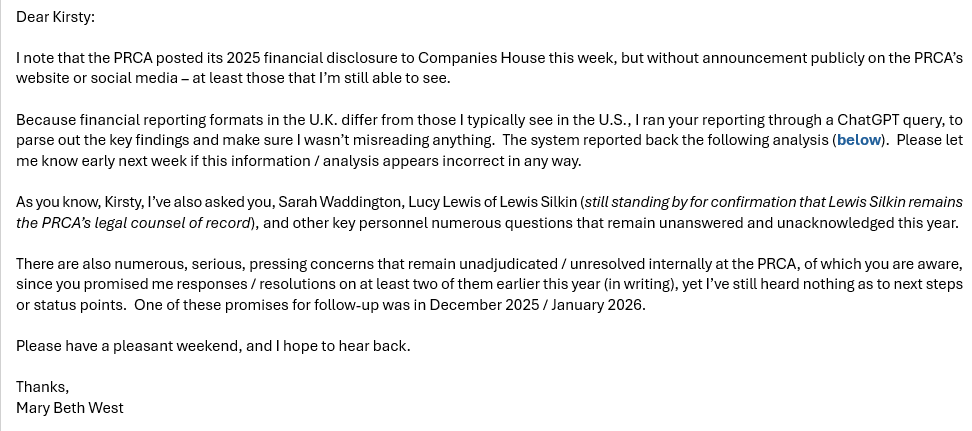
I asked for Chair Leighton / Thatcher’s response on whether a ChatGPT analysis that I ran pertaining to the PRCA finances was accurate in its run-down of the PRCA’s Companies House data, from her standpoint.
I’ve received no response / acknowledgement from Chair Leighton / Thatcher, nor from CEO Waddington, who was copied.
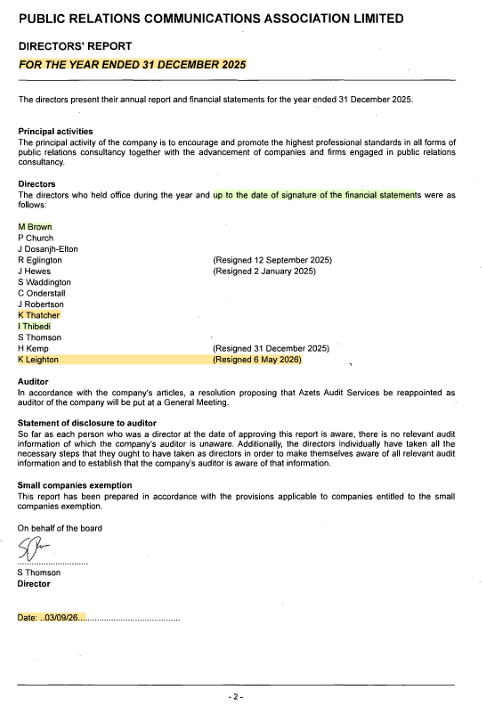
With that said, it’s further confusing, because Kirsty Leighton’s Companies House financial filing actually states that “Kirsty Leighton” “Resigned” on 6 May 2026… which is otherwise not noted in Companies House filings of that date.
I have no idea what’s going on with that…
I also have learned only in recent days that the PRCA Fellows is holding its annual Fellows Luncheon at the House of Lords on Wednesday (30 Sept), but I never received an invitation, despite being a Fellow myself.
This obvious snub underscores who the real “troll” is here, given abuses of power to retaliate against those who ask valid questions but are stonewalled / defamed instead, in the old “Kill the messenger” routine.
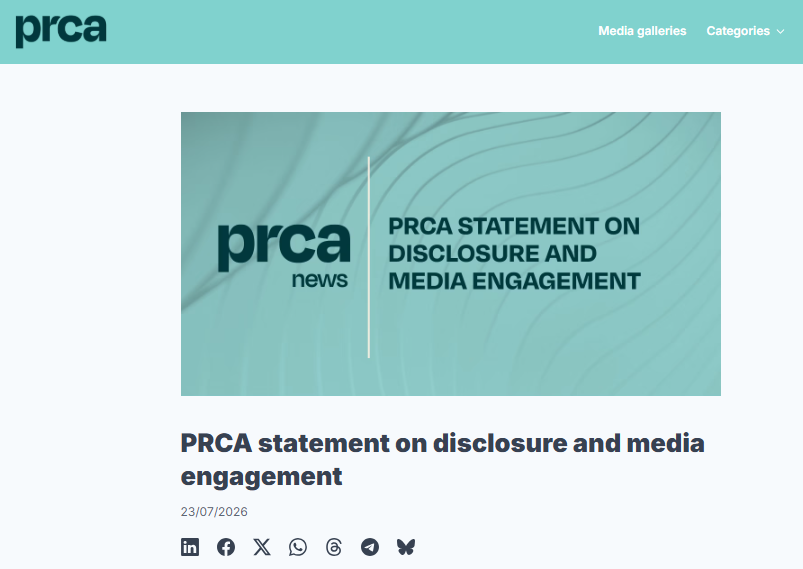
Ironically, on 23 July 2026, the PRCA released a “Statement on Disclosure and Media Engagement,” posturing that “The PRCA Code of Conduct and Code for Professional Lobbying require members to act with honesty, openness and integrity, to make clear whose interests they represent, to ensure the source of information is identifiable…”
Sounds great! Not sure why PRCA Leadership cannot follow their own counsel, when it comes to their finances:
COPY BELOW IS FROM CHATGPT, as included in above e-mail to Kirsty Leighton / Kirsty Thatcher, with copy to CEO Sarah Waddington and copy to PRCA “Standards” and “Complaints” e-mail addresses (my own highlights are added, for emphasis):
PRCA’s 2025 audited accounts are now public. Public Relations Communications Association Limited (company 00965517) filed them on 21 September 2026, ahead of the 30 September deadline. This is a new financial and governance disclosure, not another filing delay. Companies House filing history
The filed accounts show:
- Turnover fell to £3.10 million from £3.51 million in 2024, while the annual deficit narrowed to £127,963 from £248,213. Net assets fell to £266,075 from £394,038; net current assets fell to £21,337 from £130,520.
- The related-party notes disclose £94,833 paid in 2025 to Wadds Inc Limited, “controlled by Sarah Waddington,” for interim chief-executive services and reimbursed travel and expenses. Of that total, £72,000 was for CEO services from January through June. They also disclose £7,865 in training costs for services from CWE Communications Ltd, of which director Stuart Thomson is a director. PRCA says both arrangements were on normal commercial terms.
- Key-management remuneration, including directors’ remuneration, rose to £615,855 from £398,573. The accounts attribute much of the change to appointments and two people moving from contractor to employee status; the figure should not be read as Waddington’s individual salary.
The filing supplies specific amounts and counterparties for examining how PRCA governed transactions involving its leadership. It also shows a thinner year-end working-capital cushion despite the smaller loss. Those figures do not establish misconduct or insolvency: Azets issued an unmodified audit opinion and reported no identified material going-concern uncertainty for at least twelve months from authorisation of the accounts. These are accounts for the individual UK company, not consolidated group accounts. 2025 accounts and auditor’s report
One unresolved recordkeeping point: the directors’ report, signed 3 September 2026, lists Matt Brown and Ipelegeng Thibedi without resignation dates, although Companies House records their appointments ending on 8 July and 5 August 2026, respectively. That discrepancy warrants clarification, but the filing alone does not explain its cause.
The new 2025 Companies House filing strengthens the conclusion that PRCA remains under significant financial pressure—but it also shows that management reduced the annual loss substantially.
The best description is: PRCA achieved a contraction-led partial stabilization in 2025, not a financial recovery. The annual deficit was roughly halved, but revenue, staffing, working capital and reserves all declined further. Cash merely stabilized at an already depleted level.
2025 versus 2024
| Indicator | 2024 | 2025 | Change |
| Turnover | £3,513,746 | £3,103,735 | −11.7% |
| Gross surplus | £1,998,182 | £1,764,077 | −11.7% |
| Administrative expenses | £2,254,529 | £1,893,677 | −16.0% |
| Operating deficit | £256,347 | £129,600 | Improved 49.4% |
| Net deficit | £248,213 | £127,963 | Improved 48.4% |
| Cash | £163,283 | £162,956 | Essentially unchanged |
| Net current assets | £130,520 | £21,337 | −83.7% |
| Net assets/reserves | £394,038 | £266,075 | −32.5% |
| Average employees | 30 | 25 | −16.7% |
| Key-management remuneration | £398,573 | £615,855 | +54.5% |
What improved
1. The loss was almost halved
PRCA reduced its net deficit from £248,213 to £127,963. Administrative expenses fell by approximately £361,000—considerably faster than the £410,000 decline in revenue.
That indicates management took meaningful cost-reduction or restructuring measures. The employee count falling from 30 to 25 is consistent with that restructuring.
The operating-deficit margin improved:
- 2024: approximately 7.3% of turnover
- 2025: approximately 4.2% of turnover
This is genuine progress. PRCA was still loss-making, however.
2. Cash stopped collapsing
Cash was almost unchanged:
- 2024: £163,283
- 2025: £162,956
That is an important improvement over 2024, when cash had fallen dramatically. PRCA appears to have stopped the immediate cash outflow, at least at the year-end reporting date.
3. Some obligations declined
Positive balance-sheet movements included:
- Trade creditors fell from £133,388 to £91,507.
- Other creditors fell from £39,913 to £7,430.
- Accruals fell from £27,480 to £22,805.
- Lease commitments fell sharply from £94,464 to £18,144.
- Trade debtors declined from £549,712 to £430,998, potentially indicating better collection or lower activity.
These reductions are compatible with a smaller, leaner operating structure.
What deteriorated
1. Revenue contracted materially
Turnover fell by £410,011, or 11.7%, in a single year. This is the clearest negative operational indicator.
Because both cost of sales and gross surplus declined by approximately the same percentage, PRCA’s underlying gross margin remained relatively stable—about 56.8%. The problem was therefore not a collapse in gross margin; it was a contraction in the organization’s overall revenue base.
The accounts do not divide revenue among:
- membership subscriptions;
- training and apprenticeships;
- awards and events;
- sponsorships; or
- international operations.
Consequently, the filing does not reveal whether the decline came from lost members, reduced event income, lower training activity or some combination.
2. Working capital has almost disappeared
This is the most concerning new finding.
Net current assets fell:
- 2023 restated: approximately £491,593
- 2024: £130,520
- 2025: £21,337
PRCA’s current assets now exceed its current liabilities by only £21,337.
Its current ratio declined from approximately:
- 1.54 in 2023
- 1.15 in 2024
- 1.02 in 2025
A current ratio barely above 1.0 does not establish insolvency, but it leaves little balance-sheet margin for:
- a revenue shortfall;
- uncollectible receivables;
- exceptional legal or professional costs;
- membership losses;
- delayed event or training income; or
- other unplanned expenditures.
There is an important qualification: £668,305 of PRCA’s £895,179 current liabilities represents deferred income. Deferred income is generally revenue collected in advance—not necessarily an immediate cash payment owed to an outside creditor. Nevertheless, it represents services or membership benefits PRCA remains obligated to provide.
3. Reserves continued to erode
PRCA ended 2025 with only £266,075 in total members’ funds, down from:
- £642,251 at the restated December 2023 comparator;
- £394,038 in 2024; and
- £266,075 in 2025.
That is a 58.6% reduction in reserves over two years.
On the restated accounting sequence, PRCA incurred cumulative deficits of approximately:
- 2023 transitional period: £139,237
- 2024: £248,213
- 2025: £127,963
- Cumulative: £515,413
This means PRCA has consumed roughly two-thirds of the £781,488 reserve base shown at the beginning of that restated sequence.
At the 2025 loss rate, £266,075 theoretically represents a little over two years of equivalent losses. That is only a mechanical illustration—the actual runway depends heavily on cash collection, deferred-income obligations, revenue trends and further cost action.
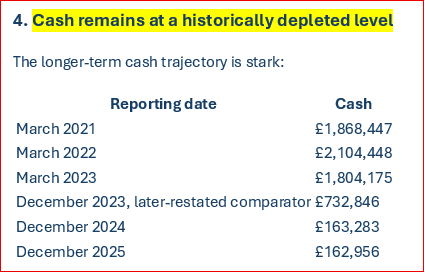
4. Cash remains at a historically depleted level
The longer-term cash trajectory is stark:
| Reporting date | Cash |
| March 2021 | £1,868,447 |
| March 2022 | £2,104,448 |
| March 2023 | £1,804,175 |
| December 2023, later-restated comparator | £732,846 |
| December 2024 | £163,283 |
| December 2025 | £162,956 |
Because PRCA changed its year-end and later restated the 2023 comparative following its treatment of PRCA MENA, these figures are not all perfectly like-for-like. Even with that caveat:
- Cash has fallen approximately 91% since March 2023.
- Cash has fallen approximately 78% since the restated December 2023 comparator.
- The 2025 result shows stabilization at about £163,000—not restoration of the earlier cash cushion.
5. Increasing dependence on amounts owed by group undertakings
Amounts owed to PRCA by group undertakings increased:
- 2024: £189,761
- 2025: £247,821
- Increase: 30.6%
That £247,821 receivable is:
- approximately 33% of all debtors;
- greater than PRCA’s cash balance;
- nearly equal to PRCA’s entire £266,075 net-asset position.
This does not establish that the money is doubtful or uncollectible. But it means PRCA’s reported balance-sheet strength depends materially on recovering funds from related group entities.
The accounts also make clear that these are individual-company accounts, not consolidated group accounts. They therefore do not provide a complete financial picture of every PRCA-branded international operation.
Management remuneration and the CEO arrangement
Key-management remuneration rose from £398,573 to £615,855—an increase of £217,282, or 54.5%—while:
- turnover fell 11.7%;
- average employment fell 16.7%; and
- the organization remained loss-making.
That headline requires qualification. PRCA explains that the increase arose partly from:
- additional management appointments; and
- two individuals moving from contractor status to employee status, meaning costs previously recorded as contractor expenses were moved into management remuneration.
Therefore, the entire 54.5% increase should not automatically be interpreted as management receiving equivalent pay raises. Nevertheless, key-management remuneration equaled approximately 19.8% of turnover in 2025, compared with 11.3% in 2024. That is a legitimate governance and cost-allocation question.
The filing also confirms that:
- Wadds Inc Limited, controlled by Sarah Waddington, supplied temporary CEO services from November 2024 to July 2025.
- £72,000 related to CEO services, calculated at £12,000 monthly from January through June 2025.
- Total 2025 payments to Wadds Inc were £94,833, including travel costs and expenses.
- Sarah Waddington entered PRCA payroll after becoming permanent CEO in July 2025.
- No money was outstanding to Wadds Inc at year-end.
- The directors state that the services were provided on “normal commercial terms.”
This is not evidence of impropriety by itself. It is, however, a material related-party arrangement occurring during restructuring, revenue contraction and board turnover, and therefore belongs in the governance chronology.
Multi-year interpretation
The financial trajectory now divides into three stages:
- 2021–March 2023: reserve accumulation
PRCA reported substantial profits in 2021 and 2022, followed by a much smaller £51,705 surplus in the year ending March 2023. Cash and reserves were comparatively strong.
- April 2023–2024: abrupt reversal
PRCA moved into deficit, changed its accounting year-end, restated its treatment of PRCA MENA, experienced leadership transition and suffered a severe reduction in cash and working capital.
- 2025: smaller but still loss-making organization
Costs, staffing and the loss were reduced, but revenue fell by nearly 12%, reserves declined another 32%, and working capital was reduced to only £21,337.
Auditor’s conclusion
Azets issued an unmodified audit opinion and stated that it:
- found the accounts gave a true and fair view;
- considered the going-concern basis appropriate; and
- identified no material uncertainty casting significant doubt on PRCA’s ability to continue for at least 12 months after authorization of the accounts.
That is significant evidence against claiming that PRCA is presently insolvent or facing imminent collapse.
The accounts also continue to disclose that NatWest holds a fixed and floating charge over all company assets. The filing does not state that NatWest has taken enforcement action.
Revised bottom line
The new filing makes the evidence of pressure stronger, but the nature of the pressure is more nuanced:
PRCA appears to have responded to its 2023–24 deterioration through restructuring, staff reduction and expense control. Those measures almost halved the 2025 loss and stabilized cash.
However, this was achieved while turnover contracted by nearly 12%, reserves fell another 32%, staff numbers declined, and the working-capital cushion shrank to only £21,337.
The organization is not auditor-classified as a going-concern risk, but its capacity to absorb another serious revenue shock is now materially smaller.
Accordingly, I would upgrade the assessment from “financially weakened and organizationally unsettled” to:
“Financially pressured, substantially restructured and operating with a very thin liquidity cushion, although not presently shown to be insolvent or subject to a material going-concern uncertainty.”
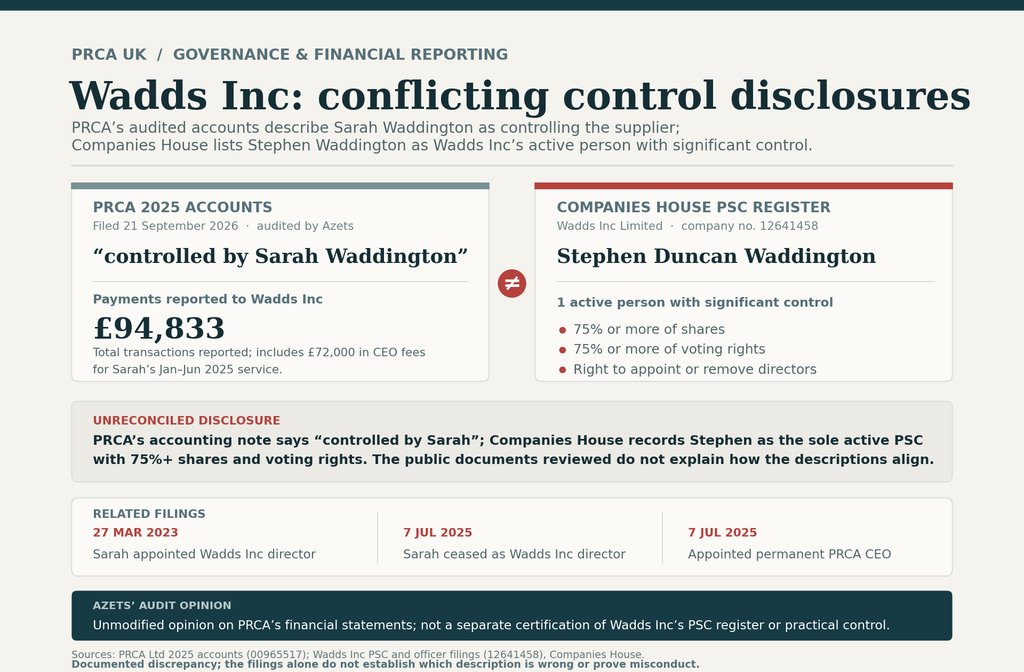
The accounts state that Wadds Inc was “controlled by Sarah Waddington.” Yet the Companies House register identifies Stephen Duncan Waddington as Wadds Inc’s sole active person with significant control, holding at least 75% of its shares and voting rights and the right to appoint or remove directors. The filing history also shows Sarah ceased being a Wadds Inc director on 7 July 2025—the exact date PRCA announced her permanent CEO appointment.
That creates two issues:
- The disclosure does not merely omit Stephen; it appears to identify the wrong controller.
- Because Stephen is Sarah’s husband and Wadds Inc received £94,833 from PRCA—including £72,000 for CEO services—the identity of the company’s controller is relevant to understanding the economic relationship and potential conflict.
The amount was approximately:
- 3.1% of PRCA’s 2025 turnover;
- 74% of its £127,963 annual deficit; and
- 36% of its closing net assets.
That makes the transaction qualitatively significant, even if Azets’ quantitative audit materiality happened to be higher.
Responsibility is divided:
- PRCA’s directors were primarily responsible for preparing the accounts, identifying related parties and approving the disclosure.
- Azets was required to audit those accounts and obtain reasonable assurance that they were free from material misstatement.
- ISA (UK) 550 specifically governs auditors’ work on related parties. The applicable May 2022 edition covered periods beginning after December 2019.
A Companies House PSC search is an elementary and authoritative check.
Stephen had been registered as controller since Wadds Inc’s incorporation in June 2020—not through some late or obscure amendment. It is therefore reasonable to ask why Azets did not require the description to be corrected or expanded.
However, it is not yet possible to conclude definitively that Azets breached auditing standards. That would require its working papers, the PRCA conflicts register, board minutes, management’s related-party representations and the engagement correspondence. Conceivable explanations include:
- “controlled by Sarah” was simply a drafting error that neither management nor the auditor caught;
- PRCA used “controlled” informally to mean that Sarah delivered or directed the contracted services, even though that would still be misleading accounting language;
- management gave Azets information inconsistent with the public register;
- Azets identified the discrepancy but concluded it was immaterial—a conclusion that could reasonably be challenged.
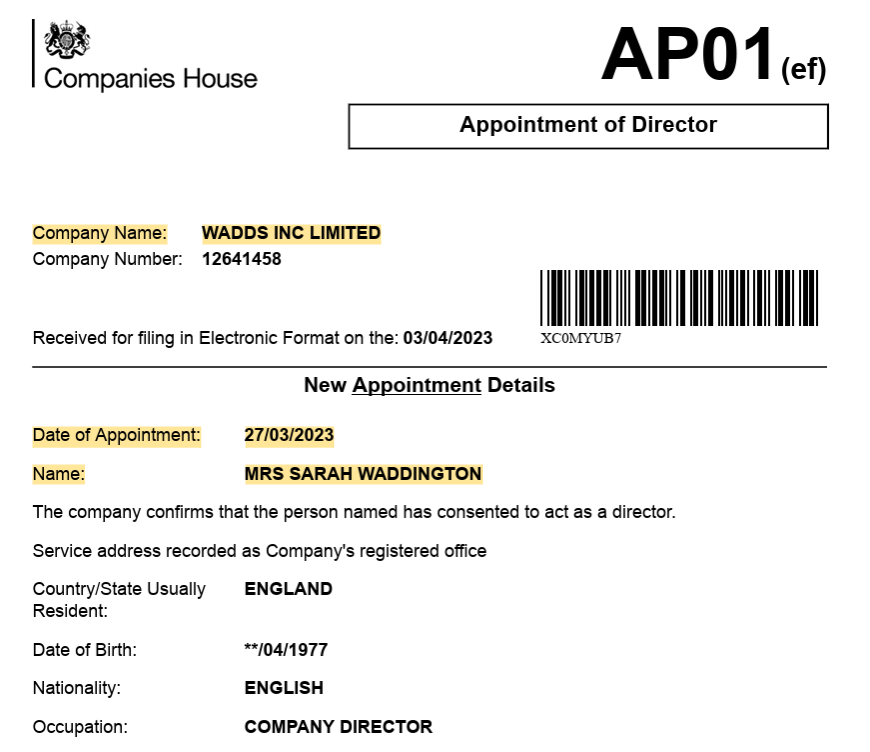
Note By Mary Beth West: Filing as “Mrs. Sarah Waddington,” now-PRCA CEO Katherine Sarah Waddington joined Wadds Inc Limited in an apparent employment capacity on 27 March 2023 — 11 days after Francis Ingham was announced dead.
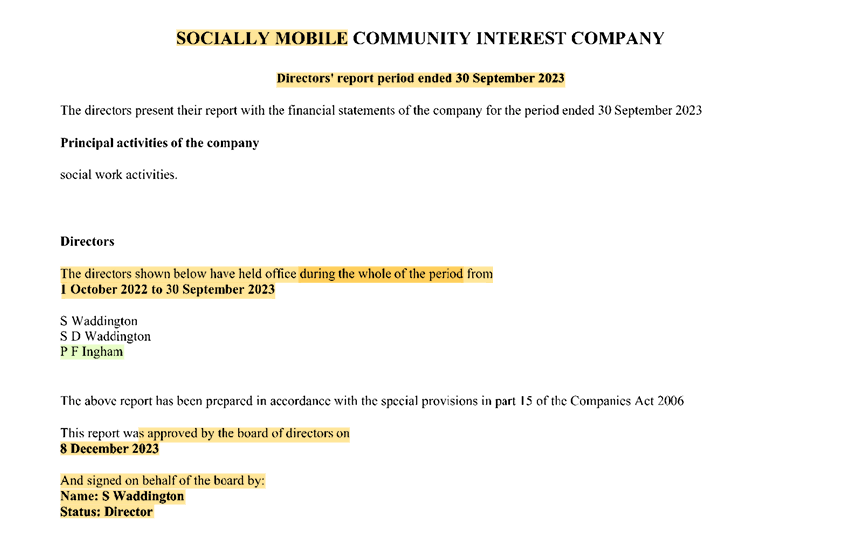
Note by Mary Beth West: Stephen and Sarah Waddington filed a false report to U.K. Companies House for their Socially Mobile CIC DEI nonprofit later that same year, on 8 December 2023, claiming “P F Ingham” (Francis Ingham) to be alive and well and still serving on their Socially Mobile board as of 30 September 2023, some six months after his 16 March 2023 death:
RESUME CHATGPT ANALYSIS:
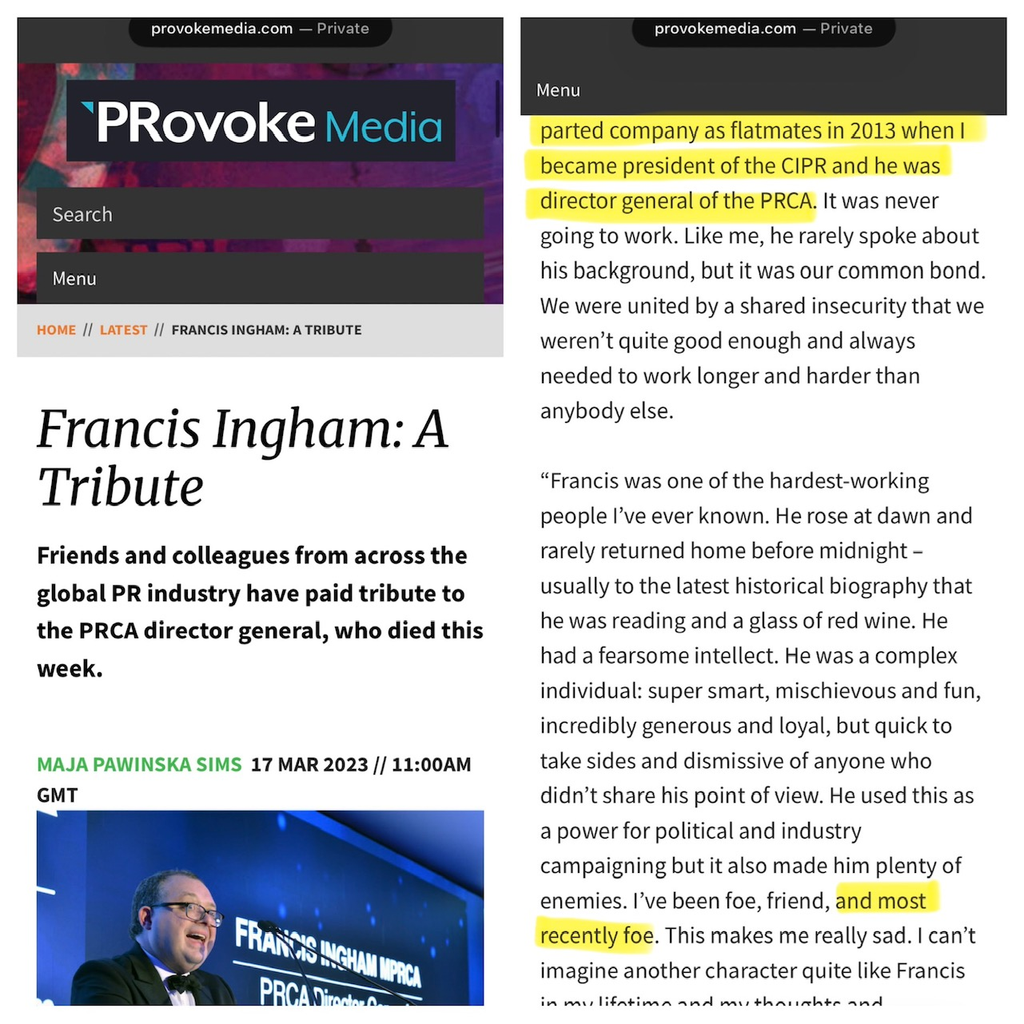
The former-flatmate relationship and any hostile “foe” statement are different. They are not automatically required financial-statement disclosures.
They become relevant if they influenced the appointment, procurement, restructuring or another board decision. Those claims should be documented with reliable sources before being presented as established facts.
https://wadds.substack.com/p/monday-briefing-francis-ingham-remembered

The strongest questions for PRCA and Azets (auditor) are therefore:
- Why did the accounts say Wadds Inc was controlled by Sarah when Companies House identified Stephen as its controlling person?
- Was Stephen disclosed to Azets as Sarah’s spouse and Wadds Inc’s PSC?
- Did Sarah declare an interest and recuse herself from approving the contract, remuneration or expenses?
- Who approved the £12,000 monthly charge and the additional £22,833?
- Was the arrangement competitively tendered or independently benchmarked?
- Will PRCA correct or formally clarify the disclosure?
I have incorporated this assessment, the Wadds Inc 2021–2025 financial history, the complete appointment chronology, and the PRCA year-over-year graphs into the revised workbook
The Companies House TM01 confirms that Ipelegeng “Ipi” Thibedi’s appointment as a director of Public Relations Communications Association Limited was terminated effective 5 August 2026. “Termination” is Companies House’s standard administrative term; the filing does not reveal whether she resigned, completed a term, or was removed.

Yet, as of 6 September 2026, PRCA’s live Management Board page:
- Still names Thibedi as a current “PRCA Management Board” member.
- States that the Management Board consists of eight directors.
- Explicitly says: “All are listed on Companies House.”
- Continues using an obsolete biography saying Thibedi is with Weber Shandwick, although she moved to Ogilvy South Africa in 2025.

The current Companies House officers register does not list Thibedi among the eight active directors. It instead lists Sarah Waddington as an active director—but PRCA’s Management Board webpage does not include Waddington among its eight displayed members.
| PRCA website | Companies House |
| Lists Ipelegeng Thibedi | Appointment terminated 5 August 2026 |
| Omits Sarah Waddington from the displayed board | Lists Katherine Sarah Waddington as an active director |
| Says all displayed directors are listed at Companies House | The two lists do not match |
Why this matters:
- It is not merely a stale historical press release; it is PRCA’s designated current governance page.
- The webpage directs readers to Companies House as confirmation, while contradicting that register.
- The mismatch had persisted for approximately one month when checked.
- PRCA’s failure to update both Thibedi’s board status and employment biography suggests weak website-governance and record-reconciliation controls.

This does not, standing alone, establish a Companies Act violation. PRCA filed the termination promptly on the effective date, so the statutory register appears properly updated. The concern is instead inaccurate public governance disclosure—especially significant because PRCA presents transparency and improved governance as outcomes of its 2023 restructuring.
I would catalogue this as: “Management Board webpage inconsistent with statutory director register after Thibedi termination.” Preserve dated screenshots of the PRCA page because it can be corrected without leaving an obvious public revision history.
(END CHATGPT OUTPUTS)
If Chair Leighton / Thatcher or CEO Waddington wish to correct any of the ChatGPT outputs as documented above that were based on the PRCA’s own Companies House filings but that somehow appear in any way incomplete or inaccurate, they are welcome to contact me with their documentation. However, they should also address multiple other pieces of correspondence sent to them this year that remain unacknowledged / unaddressed regarding additional serious questions and concerns that I have tried to register since 2025.
Mary Beth West, APR, FPRCA, can be followed on X (@marybethwest) and LinkedIn.